Credit Card vs. ACH: What Should You Actually Accept?
Sep 18, 2026 · 6 min read
Every payment method costs you something — money, time, or both. Here's how to decide what to accept without overthinking it.
At some point every solo tradesperson has to decide what they're actually willing to take as payment. Cash and check are the old standbys, but most jobs now come down to a choice between credit card and ACH bank transfer — and the honest answer is neither one is universally "better." They trade off against each other in ways that matter differently depending on the job.
The trade-off in plain terms
Credit card: Customers love it because it's fast, familiar, and they might even earn points on a $3,000 bathroom remodel. You pay for that convenience — typically 2.9% + $0.30 per transaction through most processors. On that same $3,000 job, that's about $87 out of your pocket.
ACH (bank transfer): Cheaper for you, often under 1% or a flat fee well under $10 regardless of job size, since it moves money directly between bank accounts instead of running through card networks. The trade-off: it's slower (1–3 business days to actually land, versus instant card authorization), and customers have to actively enter routing and account numbers instead of tapping a card — more friction, more chances they put it off.
Neither one is free. Credit card costs you money. ACH costs you speed and a bit of customer convenience. The question isn't which one is "correct" — it's which cost matters more for a given job.
Where credit card wins
For most day-to-day residential jobs, credit card is the right default:
- Smaller jobs. On a $200 service call, 2.9% is $5.80 — a rounding error against the value of getting paid the moment you're done, versus waiting days for an ACH transfer to clear.
- Same-day or on-site collection. If you're standing in the driveway wanting to collect before you leave, card is instant. ACH is not — it's a "send it today, see it Thursday" situation.
- Customers who don't want to type in bank details. A lot of people are simply more comfortable handing over a card number (or tapping their phone) than entering routing and account numbers into a form, even though ACH is arguably just as secure.
Where ACH wins
ACH earns its place on the bigger-ticket end:
- Large jobs where the percentage fee actually stings. On a $15,000 whole-home rewire, 2.9% is $435. The same job over ACH might cost you $5–$10 flat. That difference is real money, and on a job that size, the customer isn't collecting it in a driveway anyway — a day or two of clearing time doesn't change anything operationally.
- Repeat commercial clients. If you're invoicing the same property management company every month, ACH set up once removes ongoing card fees from every future invoice.
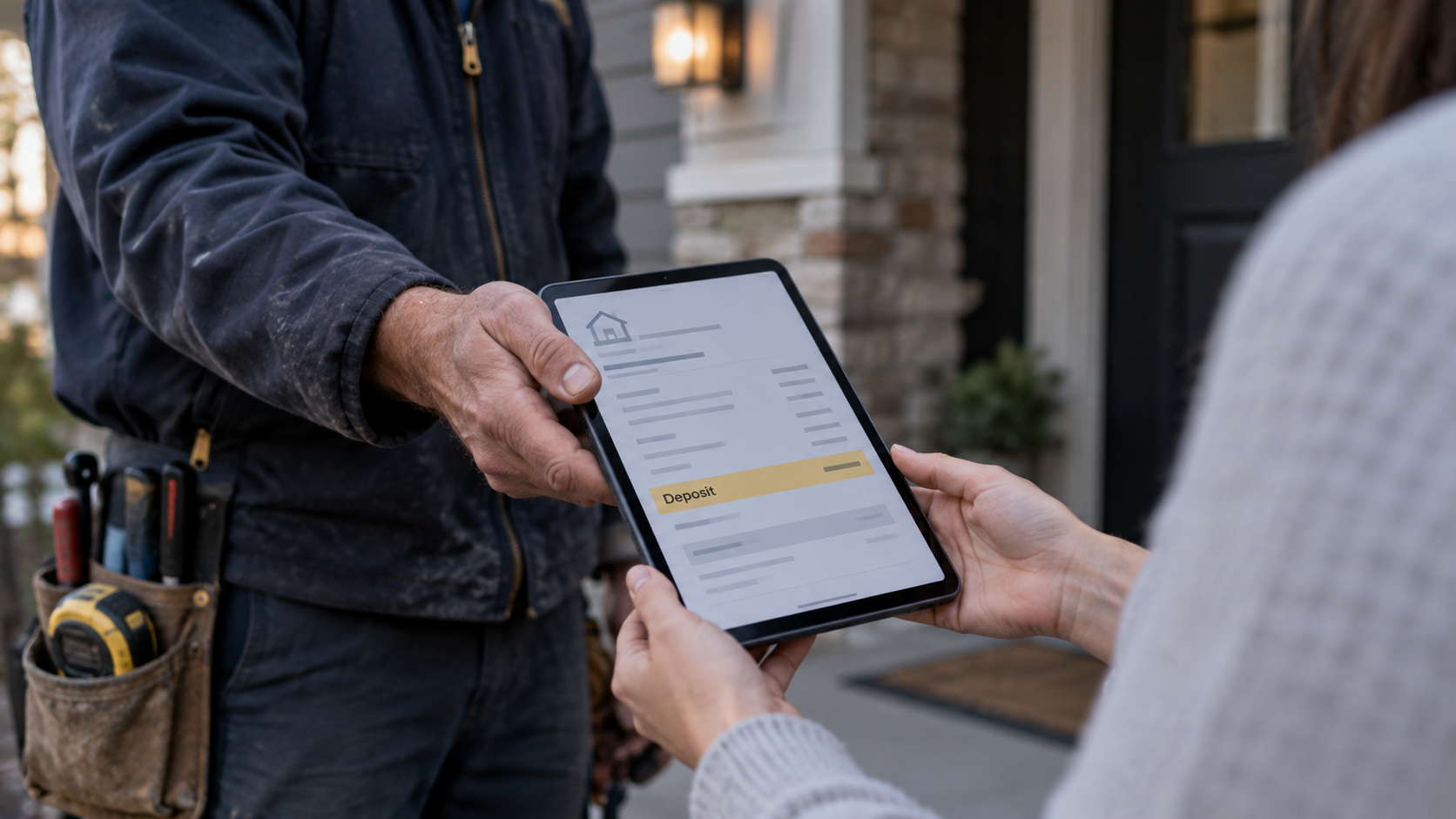
- Deposits collected well ahead of the job. If you're not standing there waiting to leave with the money, the clearing delay barely matters.
The simplest rule that actually works
Rather than trying to memorize a fee-optimization matrix for every job, most solo operators land on something like this: default to card under roughly $1,000–$1,500, offer ACH as the option above that. It's not a scientific cutoff — it's the point where the percentage-based card fee starts costing more in real dollars than the inconvenience of a day or two's wait is worth.
You don't have to pick one exclusively. The strongest setup is offering both and letting the job size (or the customer's preference) decide — as long as whatever you use to collect payment supports both without you manually toggling between two separate systems.
Don't forget cash and check
They're not gone. Some customers, especially older or more rural clients, still prefer a check, and it genuinely costs you nothing beyond a bank trip. The catch is speed and reliability — a check can bounce, and cash requires you to physically be there to collect it. They're fine as fallback options, just don't build your whole payment process around them if you're trying to get paid fast and consistently.
The part that actually matters more than the method
Here's the thing worth remembering underneath all of this: the fee difference between card and ACH is smaller than the cost of not getting paid at all. Spending real energy optimizing which processor saves you 1.5% is worth doing — but only after you've made sure customers have an easy way to pay you something, on time, without a phone call reminding them.
That's why Solo Sidekick supports both card and ACH on every invoice by default — the customer picks whichever's easier for them, and you're not manually deciding per job or juggling two separate payment tools to offer both.
Ready to stop chasing the parts of the job that aren't the job?
14-day free trial. At the end of the trial period, your card will be charged unless you cancel.
Start free trial